Showing posts with label edutainment. Show all posts

Sunday, July 8, 2012

In the end, does it really matter?


Here's the deal. Bauerlein complained a lot in this book. So much so that I was ready to call him up since he teaches here in Atlanta. I get that he has his own agenda and opinions, but one of the basic writing principles is to combat readers from saying, "Yeah, but what about (fill in the blank)?" I got encouraged from a few pages when he wrote about the ArtShow: Youth and Community Development. Then he ruined it when he complained about the work not carrying over into the kids' attitudes about school. Come on already, Bauerlein. Stop complaining and offer some solutions.

I have shared in previous posts how conflicted I feel about technology. I still feel conflicted. After a ton of reflection, I have come up with a few more questions.
  1. This is a question I have already posed, but here it is again. Are teachers part of the technology problem? I mean, the printables from the teacher handbooks are all about finding the answer to fill in the blank. Those are easier to grade. Teacher use them. 
  2. Is the problem that teachers are only working for summer break? Obviously, I don't think the answer is an unequivocal, "YES!" I do, however, think there are far too many teacher who hate their jobs, and it shows in their teaching.
  3. If we are to complain about technology stupefying a generation, shouldn't school systems STOP pushing edutainment software that promises to improve test scores?

Obviously, I had to do some pop culture research about how people feel in regard to technology in schools. I stumbled across this gem:
Please watch the entire video, otherwise my comments won't make sense. 
Maybe Ellen earned auto correct. But today's kids haven't earned anything. I like that Ellen equates writing to thinking. Awesomeness. Ellen gets it. When she brings up cavemen and communication, she does miss the idea of visuals and pictures as language. Cavemen had primitive iPads if you consider their hieroglyphs as app icons. They communicated for a purpose, which is explained well in this site I found called Caveman Communications. This guy gets it. He admits that he is a caveman, primitive. He also gets that getting back to basics is the way to go. (Okay, maybe he doesn't completely say that, but that is my take-away from him.) My point is that this Caveman offers some solutions.

But getting back to Ellen. She has a good point about iPads for kindergartners. If pediatricians recommend limiting screen time each day, why are schools pushing it as a significant part of the curriculum? 

As I am writing this, I can't help but think of the Pixar movie, Wall-E.  Is this where our future is headed?

About 2 minutes in, there is an incredibly brief scene of babies in bouncy seats watching the screen (Ellen's point about iPads?), becoming brainwashed with branding. Face-to-face communication does not exists. You talk to the person next to you via screen messaging. There is no human interaction. I get that Bauerlein is giving me a grown up version of Wall-E, but I need solutions. I know there is a problem. I am walking away from The Dumbest Generation even more dejected than before about the challenge of engaging students to become critical analyzers of the information they consume. 

I wonder if technology in the classroom is just this generation's hot topic. Back in my school days, administrators still used corporal punishment. Then it was class size and test scores. Every few years there is some reason for American kids performing poorly on tests. We don't keep up with the rest of the civilized world. I don't think technology in the classroom is destroying the American work ethic. History is. We teach kids that each generation more advanced than the previous. But are we really just teaching them to mindlessly follow along and accept whatever information they are fed? 

While this push back text offered plenty of stats to support a decision to utilize less technology in the classroom, I don't think it is realistic. Kids are too "plugged in" to their devices. If teachers come in and tell them they are the dumbest kids ever, teachers might as well hang it up. The trick is to find an appropriate curriculum that balances student-centered technology with learning-centered education instead of entertaining students with short sound bytes and watered down handouts. The problem is more far-reaching than Bauerlein would have his readers believe.


In the end, does Bauerlein have a point? We all know what he is telling us. He just dazzles us with enough statistics that make teachers want to nose dive from their mountains of federal mandates right into the falling test scores.

Saturday, July 7, 2012

Who's the problem and where's the solution?


Intermediate Response to The Dumbest Generation: How the Digital Age Stupefies Young Americans and Jeopardizes Our Future (Or, Don't Trust Anyone Under 30) by Mark Bauerlein


A couple of disclaimers are necessary before I go any further with this blog:

  1. It has come to my attention that my posts are "lengthy," so don't feel obligated to read them unless you are grading them. Read to enjoy it, not out of obligation.
  2. If it hasn't been clear yet, I have not committed to a side on the debate about technology in the classroom. I think it is overused. I think kids engage less critically in their lives (in broad terms). I think there is more to the problem than technology. Make of that what you will.

Now, back to The Dumbest Generation. I am bothered by the chapter "Online Learning and Non-Learning." I feel like Bauerlein is blaming the kids for not knowing how to appropriately use technology. Kids don't know how to use anything until you teach them. I had encyclopedias in my house as a kid (I know, I'm old), but I didn't know how to correctly "use" them until I learned about plagiarism and copyright in school. So why doesn't Bauerlein place any of the blame on educators for not keeping up with the kids? Aren't we supposed to be one step ahead of those we teach? If kids don't know how to cite resources from the Internet or figure out the validity of a website, I think teachers are the problem. If kids use the Internet to connect to the world, educators should teach them to connect responsibly.


I do agree with Bauerlein and his stats about the massive amounts of money spent on technology in schools. It seems wasteful to funnel funds to technology if it isn't helping kids get "more educated." It is great to have computers and Internet in every classroom; but if you shove 40 kids into a class, does it matter how many computers you have? There is definitely a crisis in education, and I don't think technology and its use are the root of the problem.

I also wonder this: if test scores didn't change when school went "digital," doesn't that mean technology is NOT the problem? I think there are lots of problems that have NOTHING to do with technology! Aarrgghhhh! I feel like Bauerlein is so busy bashing technology in schools instead of offering any practical solutions. Maybe there is more wrong with kids and schools than the Internet.
Bauerlein brings up some valid concerns about language acquisition in the digital age. If kids only text, email, and play video games, where do they learn communication? I get that he thinks kids get the watered-down vocabulary of popular culture. But I think it is even worse. Kids are lacking in communication in general. Like basic communication. Like making an actual phone call. Or learning to interact in an interview for a job. Digital natives are lacking in some basic skills, and I think educators the part of the problem. They expect students to come to school on day one with an advanced skill set, so they neglect to teach the basics from day one. If you miss the basics in elementary school, kids are at a deficit when they hit middle and high school. Since Bauerlein wants to bash technology in schools, spread the love and bash elementary applications, too.


In order for me to commit to a side of the debate, I need more than endless statistics thrown in my face. I want to hear about possible solutions and changes. I want to hear promise and compromise. I want to know that people are doing more than sitting around complaining. I guess I am frustrated with Bauerlein because he is doing a lot of trash talk without taking off the researcher hat and spouting some solutions. If he doesn't start offering me a ray of hope in this book, I might cry.


Sunday, July 1, 2012

Don't Hate Me Because I Read

Intermediate Response to The Dumbest Generation: How the Digital Age Stupefies Young Americans and Jeopardizes Our Future (Or, Don't Trust Anyone Under 30) by Mark Bauerlein
Since this book is about four years old, I guess the disclaimer should read "Or Don't Trust Anyone Under 34." 


So I am fairly committed to finishing this book even if I alienate the people I meet. I am trying to follow Stephen King's advice in his memoir on the craft of writing, so I have been taking this book with me whenever I anticipate the time to read. So far I have been condemned at the skating rink, the orthodontist's office, and now Starbucks. My favorite barista at Starbucks was sincerely offended, so I felt compelled to defend my choice of reading material as a line formed behind me. I now know that my barista Justin is 25 years old as of June 21 and has a masters degree in exercise science, and he hopes to work in a high school as an athletic trainer to prevent injuries in young athletes. And he is interested in older women.


Most people who know me know that I equate coffee with love, so I cannot afford to make my barista upset. Especially the barista who knows my drink order. Let's hope I can still get good coffee, but it may have to be a sacrifice in the name of research. 

At this point, I am hopeful that you have read/are reading this book, so I won't bore you with a summary (you can read that on the link above or here). I have THREE pages of notes so far, but I am planning to be as succinct as possible. But I am fired up.

Bauerlein does a great job of dazzling the reader with supported statistics about "screen time" for kids and parental lifestyles that may or may not be the reason for the excessive screen time. I will admit that I am on the fence about whether or not technology is "to blame" for kids lacking critical analysis skills or a fundamental love of reading. I do know that kids are reliant on technology. But is it as bad as Bauerlein makes it out to be? Every generation has some new convenience that the one before wasn't fortunate enough to have. Examples? Electricity, cars, telephones, supermarkets, profit sharing, automation and industrialization, assembly lines. The list is truly endless. This article shows the advances in the classrooms throughout history. It definitely helps to prove my point.

The important question for me (as a parent and hopeful future educator) is this: Is technology actually preventing progress?

Part of me says yes because these millennials or Generation M have lost the face-to-face aspect of socialization. They take everything they see and read as fact and need to be spoon fed critical interaction. They are a generation of aliterates and eliterates. They are an entire generation who don't understand that one generation ago people were embarrassed by illiteracy. This generation hasn't struggled with the aftermath of Vietnam when soldiers came home hated. They think wars are heroic endeavors that create great sound bytes and causes to anonymously rally behind. 

The other part of me says no because these same millennials have centuries of history and culture a mouse click away. They can find the answers to questions in seconds rather than the hours it took when I was young. They have a plethora of opportunities.

But they suck.

They don't care about anything other than the lastest status update or viral video.

Kids have televisions in the bedroom. And a gaming system. And a cell phone. And a computer. And internet access. And text messaging. And i-pods and i-pads. They are plugged-in. 24/7.


Bauerlein talks in chapter three ("Screen Time") about the amount of time kids zero to six and eight to eighteen spend with the screen, which included television, video gaming, computing, video watching, and prerecorded programming. The shocking thing for me is how these kids are enjoying on-demand viewing. They learn about instant gratification with Elmo DVDs at the age of 2. I think this carries over into education. They don't have time to wait for us to teach them anything. I guess that means we have to teach is fast. Teach it concisely. Teach it when they want it. Great, I have a plan. Now how to I make it work? Again, I need to have my entertainer hat so that I can find a job in edutainment.

I think this article  from Bauerlein is an interesting companion for this post since he DOES admit that these kiddos do actually READ, even though it is mostly casual text and email messaging. I come back to a question over and over again. Is it an attention issue or an interest issue? Are kids unable to focus because of their faux muti-tasking? Are they really less smart and unable to comprehend complicated ideas? Are they just disinterested in anything beyond themselves?

Stay tuned because I am certain I haven't finished with Bauerlein yet.


P.S. I won't be posting from Starbucks again. The quality of my work seems to have diminished as I shared air with so many millennials in one location.

Tuesday, June 26, 2012

Facebook = Homework

Response to "The Facebook Generation: Homework as Social Networking" by Stacy Kitsis

Okay, so my blog title is a little misleading. But only a little.

This article wasn't really on my list of favorites (based on the title), but I REALLY enjoyed it and found some reasonable classroom applications worth a try. I feel a little jaded about the whole Facebook thing, primarily because kids seem to spend too much time there. I have been trying to figure out how to use it my advantage, and Stacy Kitsis already had it figured out back in 2008.

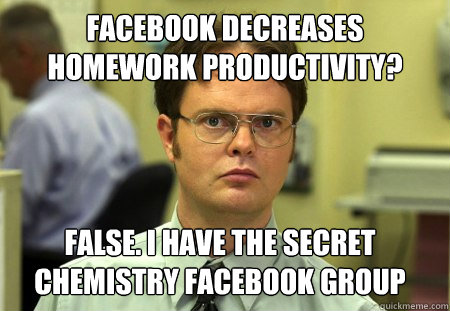
This is how I felt about Facebook and homework:
This is how I feel NOW:

Obviously, this last meme is a little over the top. Or is it?

According to Kitsis, teachers just need to treat homework like social networking. Oh, right. Make it more fun and interactive.

Some points from Kitsis I whole-heartedly agree with, but there is just one thing are just a couple of things that bother me. I subscribe to the pet-pet-slap theory, which is similar to the compliment sandwich theory, just in a different order.
I will try to stick with the sandwich theory, but I make no promises.

Verdict?

I absolutely LOVE the practical classroom applications from the article. I even looked up some homework blogs and found a good ones to model in the future. In case you haven't read the article (even though I know you wouldn't read this if you hadn't read the article), here is a quick synopsis: Kitsis basically mimics social media with the homework assignments. Students are paired to complete email exchanges over reading material (the teacher gets copied on correspondence) before large group discussions, projects, or writings. The emails have specific topics and guidelines for everyone. Another approach is the use of a blog with discussion topics. (I especially like the idea of multiple topics from which students can choose.) Students must adequately address the topic or answer the questions AND thoughtfully respond to at least one peer. There are tons of suggestions and rules about anonymity and safety that you can read in the article.

It is almost like tricking the students into enjoying the homework! But it really creates a sense of accountability among peers and fosters collaborative learning. If Vygotksy is right (and I am pretty confident he is), the sociocultural theory of education supports homework as social networking. Only in this case, the social networking benefits students academically instead of just socially. 

Kitsis also does a nice job of explaining some potential problems (and solutions) to this technologically savvy homework approach. Problems such as access to computers or Internet, unwilling partners, failing technology, and overly polite critiques are just the beginning. However, most also lead to easy solutions. Allow class time to complete assignments, grade partners individually, allow for technology failures in the schedule, and teach students clear expectations.

Okay, so I messed up the compliment sandwich already and gave away two really great compliments. Now let's talk about what I didn't like. First of all, this article is rather outdated (already). Published in 2008, this article offers a ton of great advice and practical application, but MySpace was part of the article. Sadness. The talk about class wikis also seemed outdated. Emerging technologies like Google Drive offer better collaborative work environments for students. I don't keep up with the latest stuff, so if I know about it, it can't be new. These are small potatoes in the grand scheme of the argument, really.

My biggest beef is this: Why does it always have to be fun and engaging? Kitsis makes it sound like everything in the classroom is always fun. I don't believe that can be true if educators prepare students for life. Life isn't always fun. I don't like to pay my bills. Even online it isn't "fun" to give my money away for water and electricity and Internet service. But I do it. Edutainment has a place in schools, but does it destroy our ability to teach practical skills students need in real life?

Is this where public education is heading?

I better get out my dancing shoes and creative cap if I want to teach. I have to trick them into learning, just like Kitsis did. If you can't beat them, join them. Right?